Chatmaid vs Twilio WhatsApp API: Which One Is Right for Your Project?
Chatmaid and Twilio both allow developers to integrate WhatsApp into their applications, but they target very different needs.
Twilio is the default answer when developers need to send WhatsApp messages from an application. It's a well-documented, enterprise-grade platform with a long track record. But it's not the right tool for every project — and the gap between "right tool" and "default choice" costs developers real time and money.
This is a direct comparison of Chatmaid and Twilio for WhatsApp messaging, written for developers who need to make a practical decision.
The Core Difference
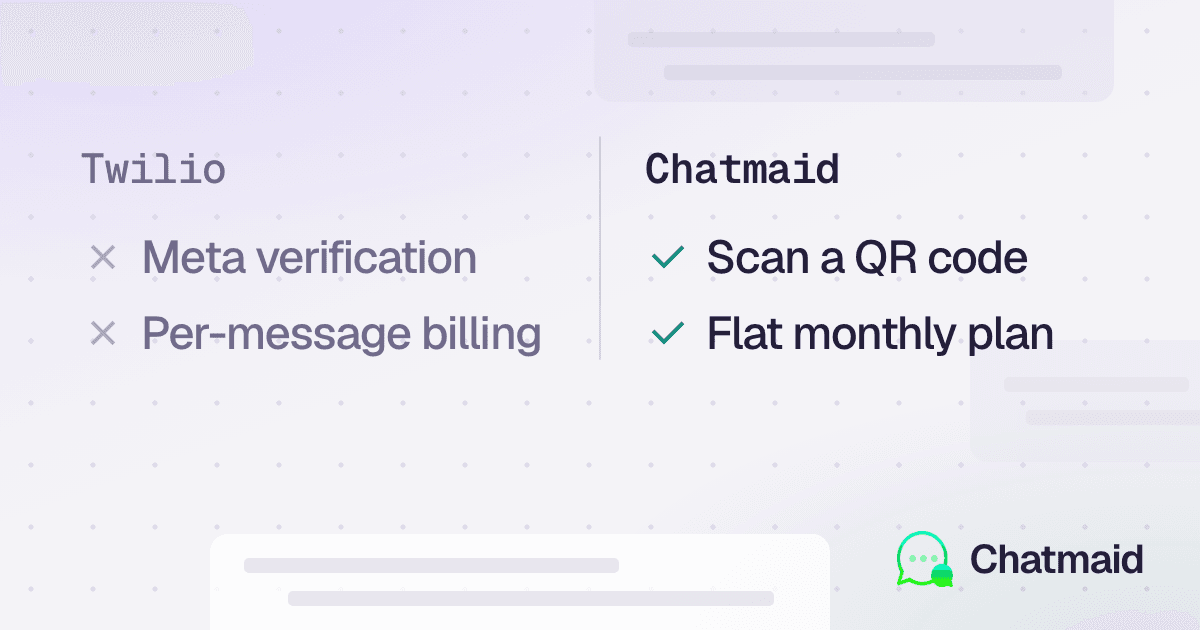
Twilio WhatsApp is built on Meta's official WhatsApp Business Platform. That means it inherits everything Meta requires: business verification, phone number approval, message templates for outbound messages, and per-conversation pricing that varies by country.
Chatmaid uses the WhatsApp Web protocol. You connect a phone number by scanning a QR code, and from that moment you can send any message — freeform, no template, no approval — to any contact. Pricing is a flat $7.99/month regardless of volume or destination country.
These aren't just product differences. They reflect completely different assumptions about who the customer is.
Head-to-Head Comparison
Setup Time
Twilio: To send a WhatsApp message through Twilio, you need:
- A Twilio account
- A Meta Business account (if you don't have one already)
- Business verification with Meta (can take 1–7 days)
- A WhatsApp-enabled Twilio phone number (requires approval)
- Pre-approved message templates for outbound messages
Realistic time from zero to first real WhatsApp message: 3–10 business days.
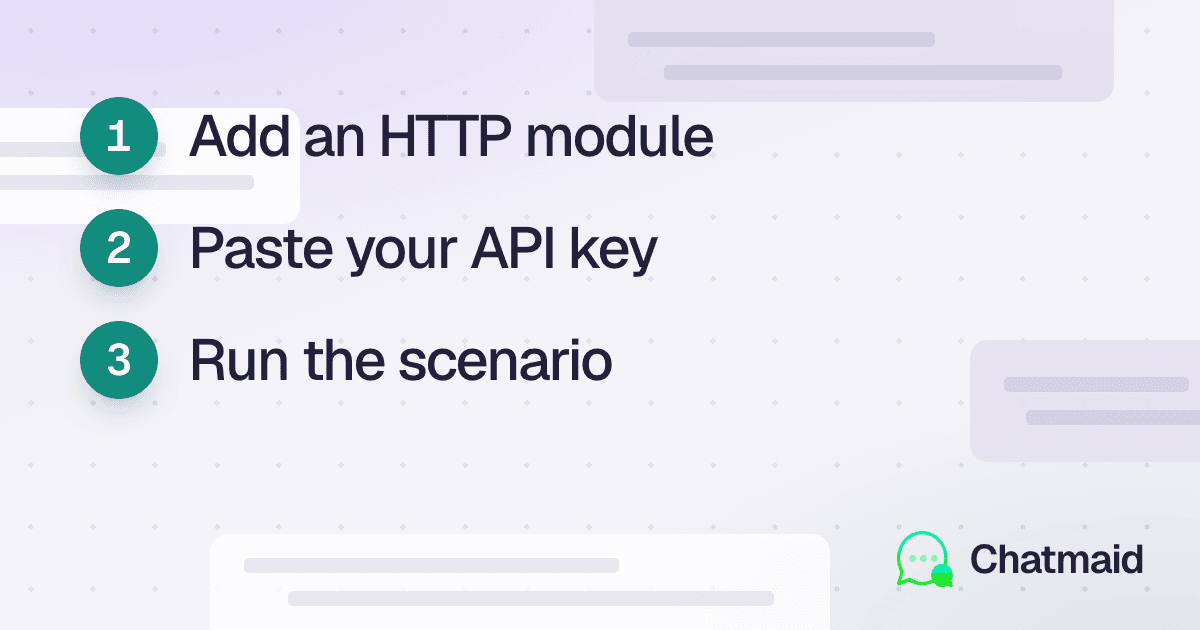
Chatmaid: Sign up, connect a number via QR, send a message. Realistic time from zero to first real message: under 10 minutes.
Message Templates
This is the biggest day-to-day friction point with Twilio.
Twilio (via Meta): All outbound messages outside of a 24-hour customer service window must use pre-approved templates. Want to send "Your order has shipped, tracking number: XYZ"? You need to submit that template to Meta, wait for approval (typically 1–3 days), and use the exact approved format. Any variation requires a new template.
Chatmaid: No templates. Send any message, any time. "Your order has shipped," "Hey, quick question for you," "The deployment failed at 03:14am" — all work without any pre-approval.
Pricing
Twilio: Per-message + per-conversation pricing. WhatsApp Business conversations are billed per 24-hour session, and rates vary by country and conversation category (marketing, utility, authentication, service). For US conversations, utility messages cost around $0.005 per conversation; marketing messages cost significantly more. High volumes or many countries mean complex billing.
Chatmaid: $7.99/month flat. Unlimited messages. $2.99/month for each additional connected phone number. No per-message cost, no country surcharges, no billing surprises.
At what volume does Chatmaid's flat rate become cheaper than Twilio? Very quickly. If you're sending more than a few hundred conversations per month — especially across multiple countries — the flat rate wins decisively.
Freeform Messaging
Twilio: Freeform outbound messages are only allowed within the 24-hour window after a customer initiates a conversation. Outside that window, you're back to pre-approved templates.
Chatmaid: Always freeform. Send any message to any contact at any time — as long as you're not behaving like a spammer (which you shouldn't be regardless of platform).
MCP Server for AI Agents
Twilio: No MCP server. To integrate with Claude Code, Cursor, or Windsurf, you'd need to write a custom MCP wrapper around Twilio's API.
Chatmaid: Ships a native MCP server (@chatmaid/mcp) with eight WhatsApp tools. Install it in one command and your AI coding agent can send and receive WhatsApp messages natively.
Sandbox Environment
Twilio: Twilio has a sandbox for testing WhatsApp — but it requires both the developer and the test recipient to join the sandbox by sending a code word to a Twilio number first. Limited test contacts.
Chatmaid: Free, unlimited sandbox with sk_test_* keys. Simulates the full message lifecycle — pending → sent → delivered — and fires real webhooks. No test recipients needed, no setup required, no credit card.
Receiving Messages
Both Twilio and Chatmaid support incoming messages via webhooks. The payload structure differs, but the capability is equivalent. Chatmaid adds HMAC-SHA256 signature verification on all webhook payloads.
Official Business Status
Twilio: Messages come from a verified WhatsApp Business account, potentially with a green checkmark for large businesses. Recipients see your business name.
Chatmaid: Messages come from your connected phone number — it looks like a message from a regular WhatsApp account. No business verification badge.
When to Use Twilio
Twilio is the right choice when:
- Your company is already a verified Meta Business — the setup cost is already paid
- You need the green business verification checkmark at scale
- You're sending millions of messages per month and have negotiated enterprise pricing
- Compliance and auditability requirements demand the official Meta API
- Your use case requires WhatsApp's official marketing message types
When to Use Chatmaid
Chatmaid is the right choice when:
- You need to send your first WhatsApp message today, not next week
- You're building a side project, internal tool, or startup MVP
- Your use case is conversational — chatbots, service agents, two-way communication
- You want flat pricing without per-message surprises
- You're building AI agents (Claude, GPT-4o, Gemini) that need WhatsApp as an output channel
- You use n8n, Make, or similar tools for automation without code
- You want incoming webhook support for bidirectional messaging
A Practical Decision Framework
Start with Chatmaid if: You want to build and ship quickly. The flat pricing and instant setup mean you can have a working WhatsApp integration in minutes, not days.
Switch to (or start with) Twilio if: You've outgrown the unofficial protocol approach, you need the verified business badge, or your compliance team requires Meta-certified infrastructure.
For most early-stage projects, Chatmaid lets you build and validate before committing to the enterprise setup that Twilio requires.